


The Post-AI CEO Profile
The Post-AI CEO Profile: More Hybrid Than Ever
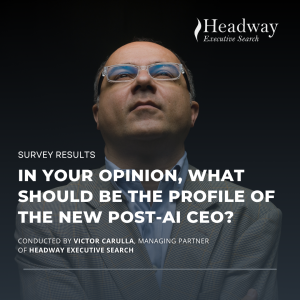 What should the post-AI CEO look like?
The survey, conducted by our Managing Partner Victor Carulla and completed by 305 participants, indicates that the ideal CEO is seen as 100% hybrid (55%), with a significant emphasis on human qualities (38%).
Global experts echo this: AI is no longer just a tool but the core of organizational transformation. The next generation of leaders must embody ethics, systems thinking, and inspiration.
Major brands are already appointing CAIOs, investing in upskilling, and redesigning leadership learning models. And according to McKinsey, AI-literate executives are 3.5× more likely to outperform their peers.
In short, the CEO of the future is a creative, adaptable leader who bridges technology, business, and humanity.
1. Interpreting the Survey Data
-
Hybrid leader (55%) – The majority clearly expects a versatile CEO who integrates technology, humanity, and business vision.
-
More human (38%) – A strong secondary preference showing that empathy and personal leadership remain critical.
-
More technical (3%) and More commercial (4%) – Minimal support, suggesting that leaders are now valued more as integrators than specialists.
2. What Leading Global Media and Experts Are Saying
2.1 AI Is Redefining the CEO Role
According to Gartner, CEOs no longer see AI as a tool but as a central element to reinvent operating models and people strategies (TechRadar).
2.2 Focus on Culture and Experimentation, Not Just Technology
TechRadarPro highlights that leadership must evolve from endorsing AI to actively engaging with it—building a culture of experimentation, learning, and transparency.
2.3 The Rise of the Chief AI Officer (CAIO)
Brands such as Lululemon, Nike, and Estée Lauder are creating CAIO roles that combine technical expertise, transformation, governance, and ethical stewardship (Vogue Business; SHRM).
2.4 Ethics and Systems Thinking as Shields Against Automation
Autodesk’s CEO promotes “total systems thinking”—a holistic leadership approach that blends creativity, empathy, and systemic understanding to counterbalance automation (Economic Times).
2.5 Expanding Leadership Roles in the AI Era
The Financial Times notes that managers must evolve into facilitators of ideas, evaluators, change guides, and talent guardians in the face of automation (FT.com).
2.6 Upskilling as a Strategic Imperative
Leadership studies emphasize that CEOs must lead by learning—integrating hands-on AI education, feedback loops, and role-based learning systems (BVP.com).
2.7 Irreplaceable Human Competencies: Empathy, Curiosity, Transparency
Forbes underscores emotional intelligence, adaptability, and transparency as timeless skills in the AI age (Forbes).
The World Economic Forum adds that managing AI agents will require critical verification, creativity, trust-building, and resilience (WEF).
2.8 Companies Led by AI-Fluent Executives Grow Faster
McKinsey reports that leadership teams proficient in AI are 3.5× more likely to outperform their sectors in revenue and decision-making speed (Lolly Daskal).
2.9 Transformation in Practice
AIG, under CEO Peter Zaffino, has integrated generative AI into underwriting, boosting both efficiency and operational resilience (TIME).
